
Im Rahmen der Vortragsreihe „Theater Forschung Ruhr“ stellen internationale Forscher*innen ihre aktuelle Arbeit in einem wissenschaftlichen Vortrag vor. Die aktuellen Veranstaltungen werden jeweils unter Veranstaltungen angekündet.
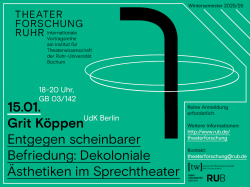
Donnerstag, 15. Januar, 18 Uhr, Uni Campus, GB 03/142
Dekoloniale Ästhetiken sind keineswegs auf Begriffe und Praktiken wie „de-linking“ (Walter Mignolo) oder „un-learning“ (Gayatri Spivak) allein zu reduzieren, auch wenn diese in der späten Rezeptionsgeschichte des Dekolonialen Prominenz im Diskurs gewonnen haben. Allein in Bezug auf aktuelle Theatertexte von afrikanischen und afro-diasporischen Autor*innen lässt sich ein breites Spektrum dekolonialer Ästhetiken identifizieren. Ausgehend vom empirischen Material – den Stücken selbst – argumentiert Grit Koeppen , dass sich das Spektrum dekolonialer Ästhetiken mindestens zwischen zwei Polen aufspannt, einer Ästhetik des Aufruhrs und einer Ästhetik der Transgression.
„Wir sind im Krieg. Lasst uns im Krieg bleiben“, sagt eine der Figuren im Modus des Aufruhrs in Dieudonné Niangounas Stück „Nennt mich Muhammad Ali“. Das lässt sich gleichermaßen als drastische Provokation und als Resonanz auf die globale postkolonial-kapitalistische Situation lesen. Im zeitgenössischen Sprechtheater afrikanischer und afro-diasporischer Autor*innen wird die koloniale Situation mit einem Aufschrei erinnert und die postkoloniale Situation als Folge der Gewaltverhältnisse scharf kritisiert. Mittels Theater nehmen Künstler*innen hier eine widerständige Erhebung gegen rassistische, klassistische und sexistische ökonomische, körperpolitische und sprachliche Zurichtungen vor. Zugleich ist in den Stücktexten eine Ästhetik der Transgression gestaltet, bei der dekoloniale Visionen von Welt möglich werden.
Wie wird die aktuelle postkoloniale Realität im Theater reflektiert? Was wird aus Perspektive subalterner Figuren in den Stücktexten artikuliert und gespiegelt? Was entäußert sich im kritischen Blick auf den Westen? Wie gestalten Bühnenautor*innen eine Ästhetik des Aufruhrs und eine Ästhetik der Transgression? Lassen sich dem gegenüber aus den Stücktexten, ihren Dramaturgien, konzipierten Figurenrelationen und -reflexionen auch künstlerische und gesellschaftliche Utopien ableiten?
Grit Köppen ist seit 2024 Gastprofessorin an der Fakultät Darstellende Kunst der Universität der Künste Berlin. Sie lehrt seit 2017 im Bereich Szenisches Schreiben an der UdK. Dieses Jahr erschien ihr Buch „Dekoloniale Äshetiken im zeitgenössischen Theater“ bei Theater der Zeit. www.gritkoeppen.de
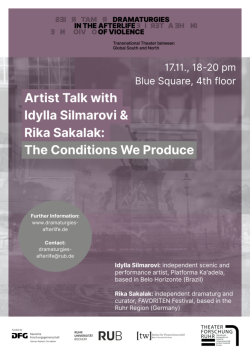
Montag, 17. November, 18 Uhr, BlueSquare, Etage 4
The so-called free theater scene is increasingly shaped by small, temporary working groups in favor of enduring regional and global networks. This talk invites the scenic and performance artist Idylla Silmarovi (Ka’adela Platform, Belo Horizonte) and the dramaturg and curator Rika Sakalak (FAVORITEN Festival, Dortmund), each from distinct local contexts, to discuss how conditions of production shape contemporary artistic practices and their aesthetic formats. Which educational, cultural, and political guidelines condition residencies and collaborations? What aesthetic and political processes can—or cannot—emerge from the infrastructures that host them? What traps and contradictions confront guerrilla, decolonial, Black, and feminist strategies under the cultural policies of „sovereign diversity“ proposed by institutions such as UNESCO and embraced by neoliberal democracies? Where do artistic ideas meet—or attempt to transgress—these institutional frameworks in imagining a desirable, yet still unknown, world. Mediation: Felipe dos Santos Boquimpani (Institute for Theatre Studies, RUB)
Idylla Silmarovi is a performing artist and researcher. She holds a Master’s degree in Performing Arts from the Federal University of Ouro Preto, with research entitled „Strategies of art in a state of guerrilla warfare.“ Born Contagem (Brazil) she investigates the intersections between art and activism within the performing arts, mainly regarding the debate surrounding memory as a right denied by the colonial system in Abya Yala (Americas). In addition, her practice and research are directly related to feminist and racialized LGBTQIA+ struggles. Idylla is the creator of the Ka’adela Platform and the Meeting Zone. She also collaborates with various collectives and movements such as Cia Brasileira de Teatro, Toda Deseo, Plataforma Divinas, Academia TransLiterária, Cia Circunstância, and was artist-in-residence at PACT Zollverein and Frankfurt LAB°.
She creates autonomous spaces for creation. She seeks to sink caravels.
Rika Sakalak, born and raised in Athens, works as a dramaturge, curator, and diversity manager in North Rhine-Westphalia. She earned two Master’s degrees in Comparative Literature and Theatre Studies at Ruhr-University Bochum (RUB) in 2022 and has co-edited articles and anthologies as well as held a teaching assignment on Dramaturgies of Resistance at the same University in 2023. Since 2021, she has freelanced as a dramaturge and curator with artists, collectives, and festivals. From 2022 to 2024, she was dramaturge at Ringlokschuppen Ruhr, managing cultural networks such as LAG Soziokultur, four.ruhr, the Tanzproduzent*innen Konferenz (TPK), and Landesförderung Neue Normalität. She collaborates with Nora Amin, Martin Ambara, Kati Masami Menze, and Édith Voges Nana Tchuinang. Rika is an elected member of the Bochum Cultural Commission and deputy chair of Kunst und Handlung e.V..
Currently Rika is artistic director of the FAVORITEN Festival (2026) with Jonas Leifert and dramaturge/coordinator for West Off Festival.
WiSe 2025/26
SoSe 2025
WiSe 2024/25
SoSe 2024
WiSe 2023/24
SoSe 2023
SoSe 2022
WiSe 2021/22
SoSe 2021
WiSe 2019/20
SoSe 2019
WiSe 2018/19

Copyright © TW 2025
Letzte Änderung: 17. Dez. 2025