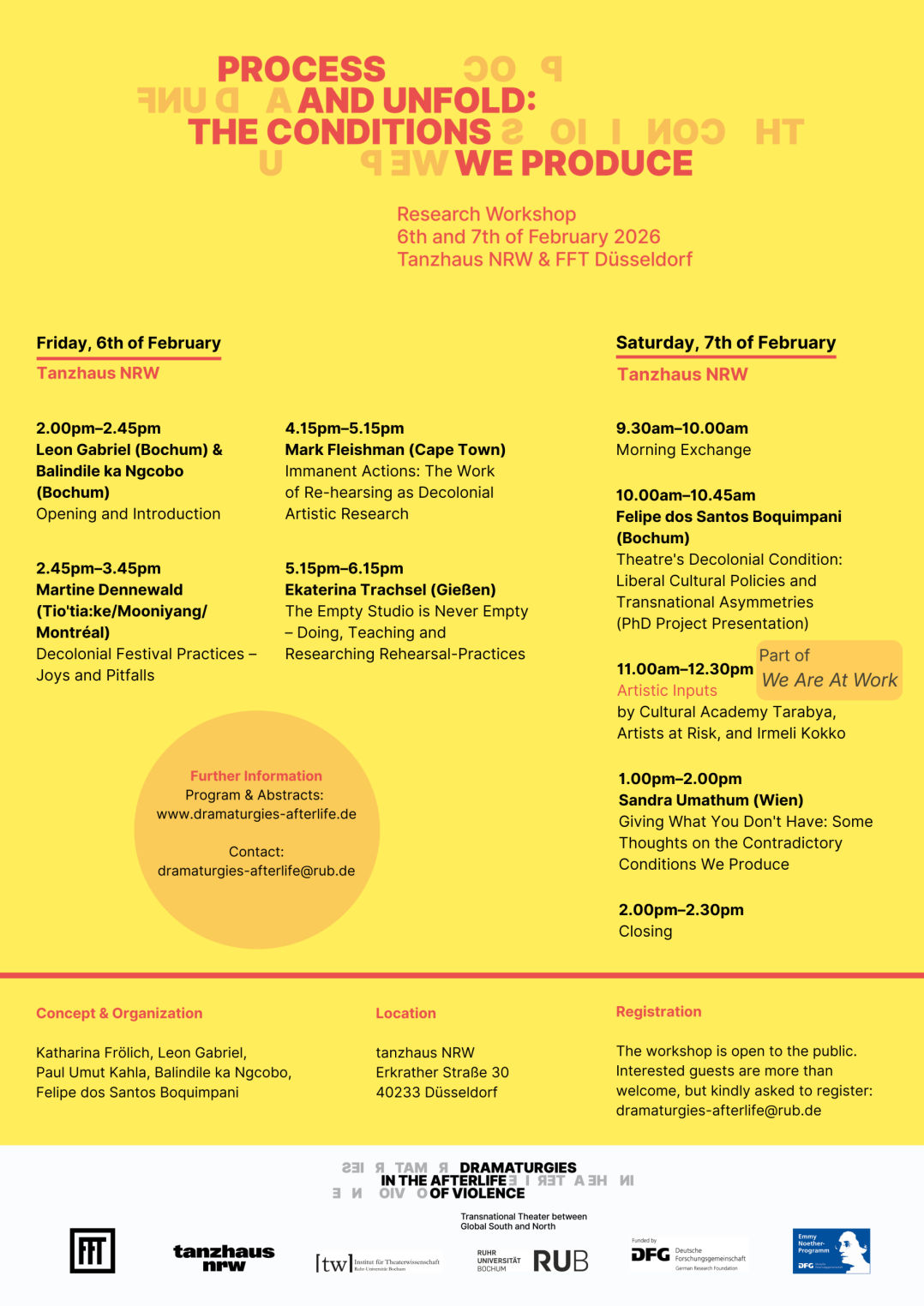
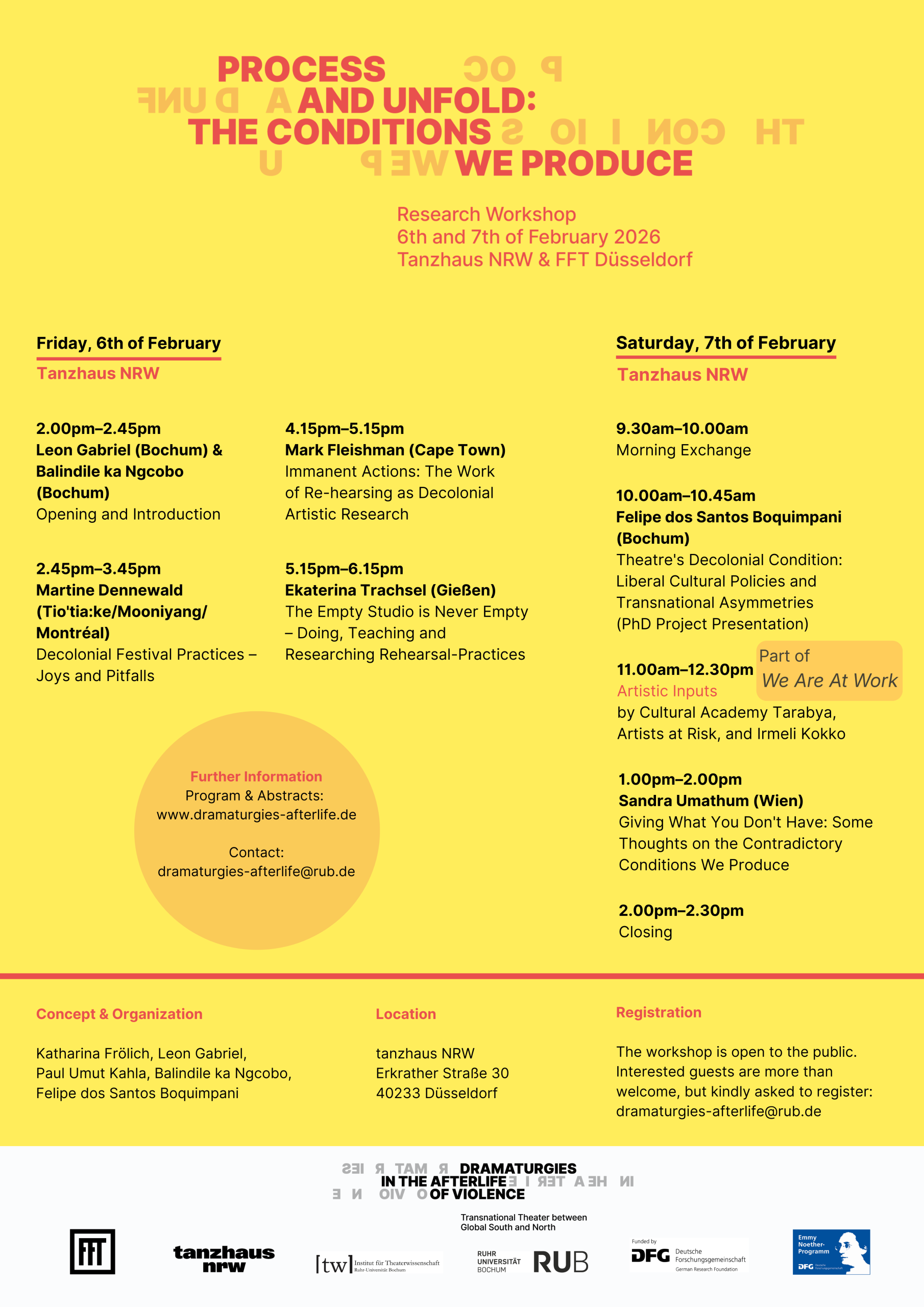
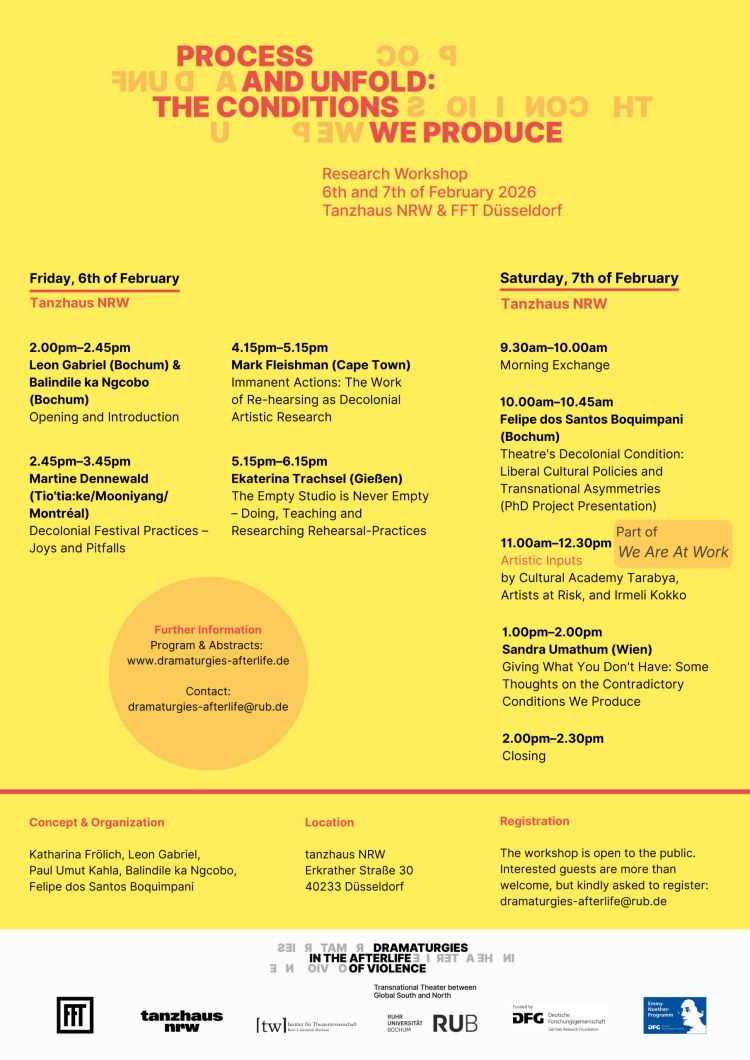
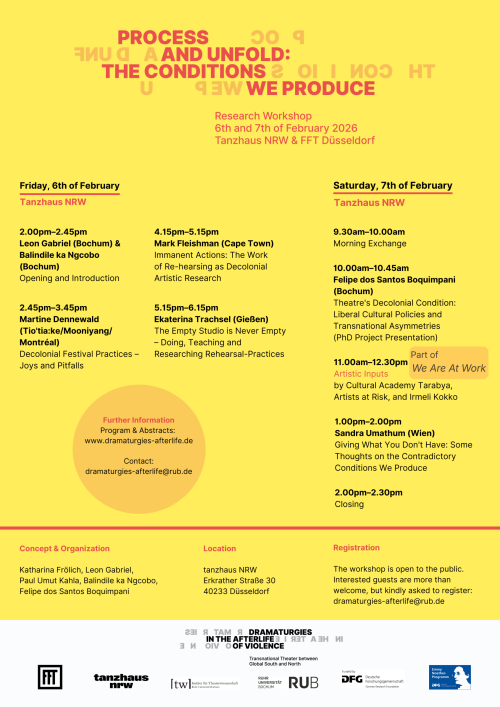
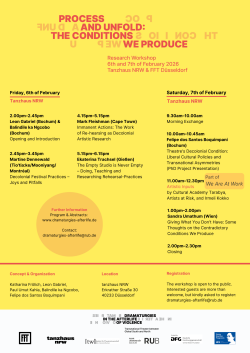
This workshop deals with the working methods that are being developed in the performing arts – specifically those that critically examine colonialism, extractivism, or other forms of exploitation/subjugation in their very own modus operandi. Can best practices be identified here? How do these methods deal specifically with the existing asymmetries between artists from underprivileged structures and European institutions? What is the potential of artistic research for the transformation of art institutions and infrastructures in this regard? Ultimately, however, there is also the question for artists themselves: How do you work? And quite simply: Why do you engage in the kind of criticism of, for example, neocolonial structures that you do, in and with art? What possibilities does this offer, and where does it encounter contradictions in your work and production conditions? With these questions, the workshop investigates the processuality of theater and performance on the one hand, and the discursive authority of institutions on the other: in other words, experimenting with the material as opposed to fixing on themes, focal points, definitions, trends, etc. – and, quite explicitly, the reduction of many performances to labels such as "decolonial theater."
Workshop with Martine Dennewald (Tio'tia:ke/Montréal), Mark Fleishman (Cape Town), Ekaterina Trachsel (Giessen), Sandra Umathum (Wien)
Venue: Tanzhaus NRW Düsseldorf and Forum Freies Theater Düsseldorf
Full reader here.
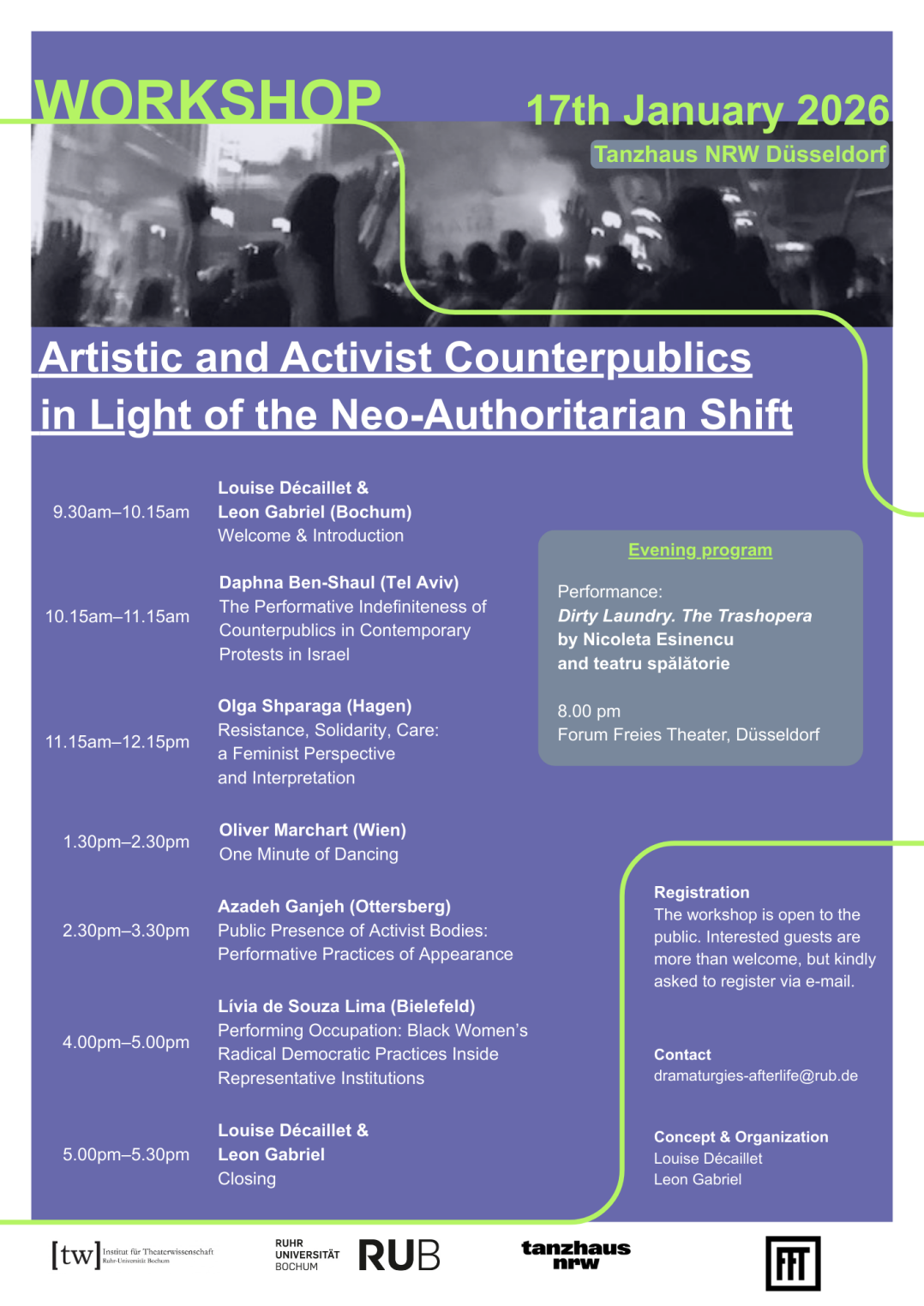
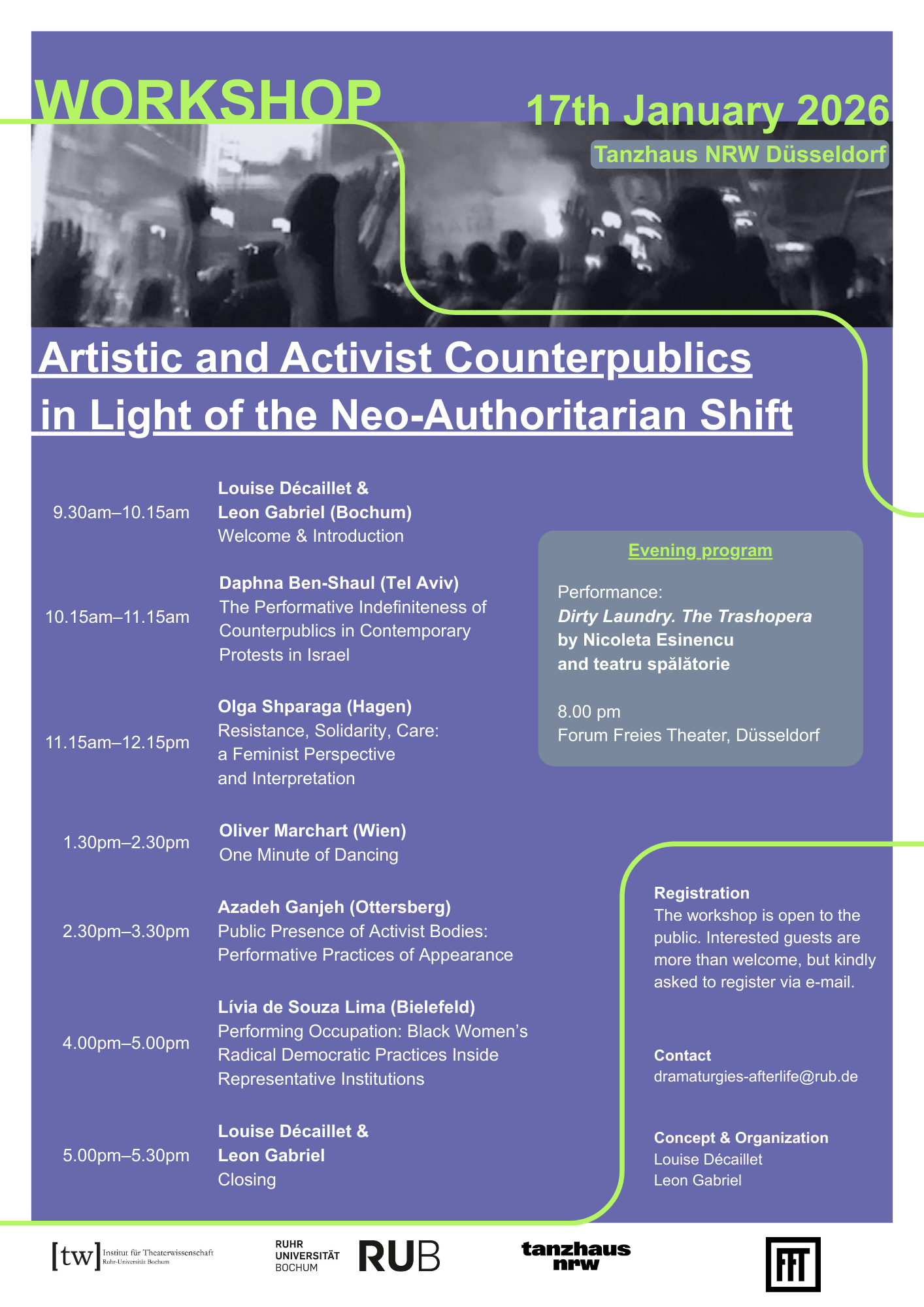
The neo-authoritarian tendencies that today threaten democracies on a global scale take on unique forms depending on cultures and forms of government in which they develop. Alongside the decisions of state power such as the tightening of migration policies, attacks on justice and the separation of powers, freedom of the press and academic research, we also witness a brutalization of social relations manifested through antifeminist backlash and queer- and transphobia, the rise of racist and anti-Semitic attacks, and the ever-stronger presence of identitarian far-right groups in the public space – as well as their digital violence. While this brutalization clearly endangers democratic life itself, it also urges to reexamine the very spaces and practices of protest and opposition, of resistance and solidarity, as well as their political performativity. Therefore, this workshop aims to discuss the new challenges faced by contemporary counterpublics and counter-communities in different world regions and the practices of resistance they enable against neo-authoritarian politics. How do these practices of assembling, protesting and commoning emerge in the face of their ongoing repression, and how do they oppose not only state power, but also attempt to escape other forms of economic, political, social, and cultural domination? How do artists and activists utilize digital, street, and community spaces to express their demands, forge alliances, and create alternative spaces of togetherness? And how are they testing other forms of society?
Workshop with Daphna Ben-Shaul (Tel Aviv University), Azadeh Ganjeh (HKS Ottersberg), Oliver Marchart (Universität Wien), Olga Shparaga (Fernuniversität Hagen), Livia de Souza Lima (Universität Bielefeld)
Venue: Tanzhaus NRW Düsseldorf and Forum Freies Theater Düsseldorf
Full Abstract here.
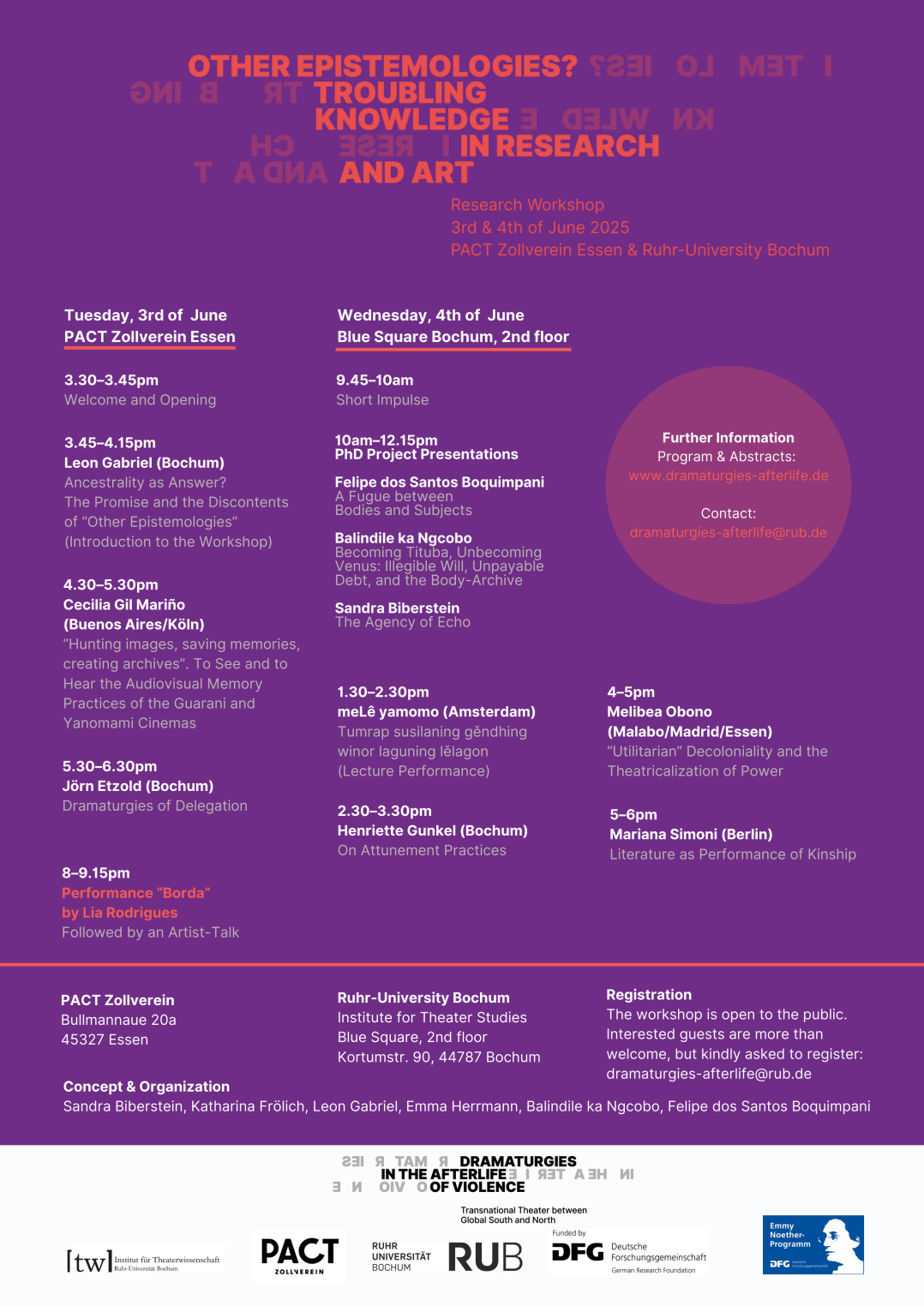
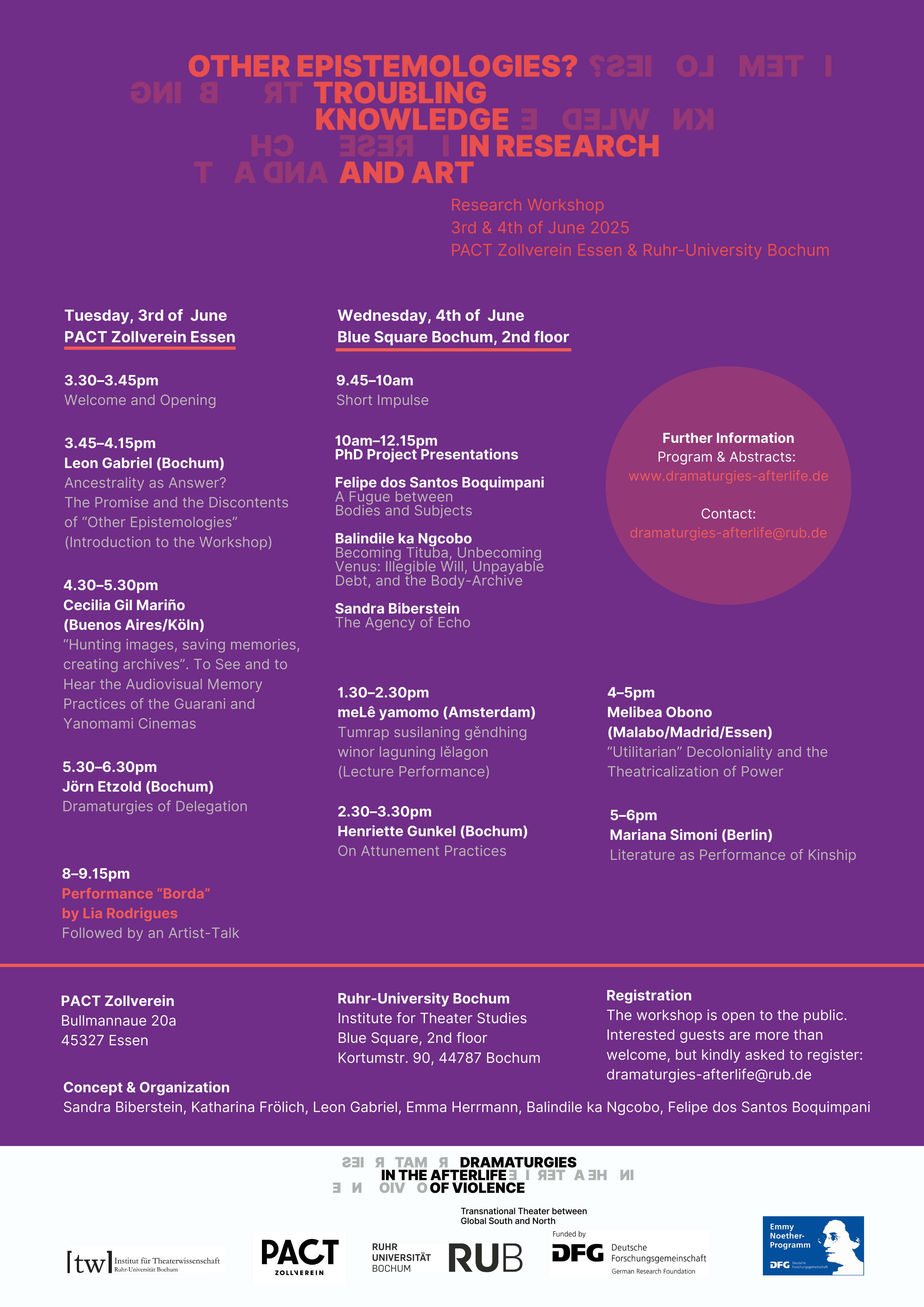
Knowledge is never innocent. At the heart of the current planetary crisis lays an order of viewing, thinking, and knowing the world as to consume. As this entanglement becomes more and more apparent today, an urge for ‘other epistemologies’ can be observed, especially in the humanities and the arts: ways of engaging with humans, animals, more-than-humans and environments that do not fall into forms of mere appropriation or even violence. With good reason, the historic and ongoing modes of objectifying living beings and things for exploitation are being problematized. This concerns for example the colonial heritage of archives or the different forms of extractivism, but also the very mode of ‘scopic knowledge’. Therefore, the universality of Western – that means Eurocentric and US-American – knowledge is being criticized and former ‘peripheric’ epistemes/epistemologies are being highlighted – for example indigenous knowledge.
The two-day research workshop takes up these abovementioned discussions and asks: How does aiming for non-western epistemologies change the assumption of center and periphery? Can it go beyond existing power structures? Or is it just another way of extraction, appropriation, and silencing? Where are common grounds between different epistemologies, for example considering questions of human rights?
More precisely regarding the arts: How do theatre, dance, performance, films etc. engage with different ways of knowing and experiencing in the world? For example, which kinds of explorations of the sonic or the tactile are being undertaken, but also of ‘other modes’ of seeing? How can the different arts challenge dominant forms of knowledge? To what extent do they not only change, but also create new epistemologies through their aesthetic or artistic/performative practices?
The first workshop day will take place at the choreographic center PACT Zollverein in Essen and includes the new performance “Borda” by Brazilian artist Lia Rodrigues in the evening, followed by an artist talk. The following day, the workshop will continue at BlueSquare, Ruhr-University Bochum.
Workshop with Dr. Cecilia Gil Mariño (Buenos Aires/Köln), Dr. Melibea Obono (Malabo/Madrid/Essen), Jr.-Prof. Dr. Mariana Simoni (Berlin), Prof. Dr. meLê Yamomo (Amsterdam) as well as Prof. Dr. Jörn Etzold (Bochum) and Prof. Dr. Henriette Gunkel (Bochum), in collaboration with PACT Zollverein.
Venue: PACT Zollverein Essen on 3rd of June & Ruhr-University Bochum, BlueSquare (Kortumstr. 90, 44787 Bochum), 2nd floor, on 4th of June

Copyright © TW 2026
Letzte Änderung: 03. Feb. 2026